
As most of us experience from elementary school through college, math class tends to focus on the “proper way” to solve problems. The reason given is that the wide range of techniques and skills that can be applied to a math problem need to be learned and mastered one at a time. If math class was simply figuring out on your own how to solve a problem, you might develop a method that works for the specific problem you did, but not every problem of its kind. It is better to make sure everyone is solving it the “right way” than to let students explore different approaches.
While I understand why teachers like this approach, there are so many opportunities in math for people to express their creativity that get overlooked because of a strict focus on rules. Yes, math is built on a foundation of strict rules, but those rules are more beautiful than we often give them credit for, and they can be wielded artistically. I want to encourage people to explore the creative side of math, so here are some examples of the beauty of math (this will be very nerdy; I am not sorry).
- Pascal’s Triangle
Start with the number 1. Below it (1 row below), write a pair of 1’s like they were the branching roots of a tree. For each row below that, begin and end with a 1 and add up the two numbers above to make the next branch. Those are the rules to Pascal’s Triangle.
1
1 1
1 2 1
1 3 3 1
1 4 6 4 1
1 5 10 10 5 1
1 6 15 20 15 6 1
…and so on, forever. This pattern has been known for over a thousand years, and has been independently discovered by cultures around the world. The different ways that this pattern can be used boggles the mind. Here are just a few:
- By adding up all the numbers in a row, you get a number twice as big as the previous row’s sum. That means you can use Pascal’s Triangle to visualize powers of 2 in a new way.
- If you are in Algebra, and don’t want to go through the grunt work of distributing (FOIL-ing) out a polynomial expressed as (x+y)n, you can look at the n+1 row of Pascal’s Triangle and each number, in order, will give you the coefficient of each term. For example, (x+y)4=x4+4x3y+6x2y2+4xy3+y4. I didn’t do any algebraic distribution for that, I just looked at Pascal’s Triangle. If you notice how I ordered the powers of x and y, you may start to see how this is just as useful in combinatorics. For example…
- If you have ever seen or played the game Plinko, the shape of Pascal’s Triangle maps perfectly onto the board. On top of that, if you look at the number on Pascal’s Triangle that matches the hole you are aiming for, that number tells you how many different paths lead to that hole. Divide that number by the sum of that row, and you get the odds of landing in that hole. This can be used to explain why prizes are located where they are on the board, since it makes sense to place bigger prizes where you are less likely to land.
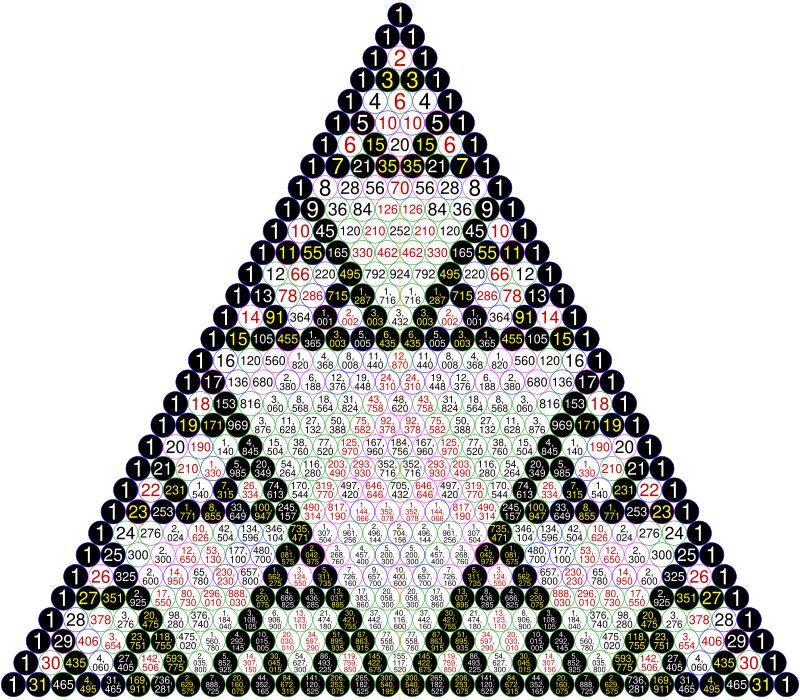
Those are just the first three examples I found and understood. I didn’t even talk about what happens when you start coloring in Pascal’s Triangle. In fact, if you only color in the odd numbers, you get something that resembles the next cool math concept I want to talk about!
- Fractals
The story goes that mathematician Benoît B. Mandelbrot was interested in an exact measure of the coastline of Great Britain. Maps can only be drawn with so much precision; every time you zoom in you find new details. Those new details are extra bits of coastline you need to add to your measurement. Mandelbrot noticed that the zoomed-in bits of coast he analyzed were often similar to the larger coastline. If this trend went on forever, then Great Britain could have a finite area, but an infinitely-long coastline (perimeter) with copies of itself descending forever into more micro-copies. This would only work in Math-Land, where you aren’t bound by grains of sand or atoms, but luckily for Mandelbrot that was where he preferred to work. He went on to found the geometric study of fractals: geometric shapes that go on forever and contain copies of themselves at smaller scales.
If you look again at the colored-in Pascal’s Triangle, you may notice the uncolored, upside-down triangles which comprise Sierpinski’s Triangle: a fractal made by splitting a triangle into 3 right-side up triangles and one central upside-down triangle. That is the only rule you need to follow to draw your own Sierpinski’s Triangle because after you split it up once, you now have 3 new triangles to split up again.
…and again
…and again
…and again until you can’t draw any smaller triangles.
So many beautiful and intricate shapes can be made by following simple rules. The Dragon Curve can be made by folding paper in half certain ways (or by copy/pasting with a rotation), Koch’s Snowflake emerges by adding a triangle to the middle of each line of a starting triangle, and the shape Mandelbrot is most famous for involves repeating a short equation ( z2+c ) and seeing what happens.
Fractals are some of my favorite shapes to draw. I am by no means an artist, so the idea that I can follow simple, straightforward rules and produce an image more complicated and beautiful than I imagine my skill allows is always a joy. One of my favorite memories from childhood is cutting snowflakes out of paper. A few folds and a couple cuts turned a flat sheet of paper into art. Now I aimlessly doodle Koch’s Snowflake, my pencil drawing me ever closer to the complexity of the tiny crystals I still catch on my tongue in winter. Math is made up of rules, but it is in the interpretation of those rules that we can find beauty.
Dragon Curve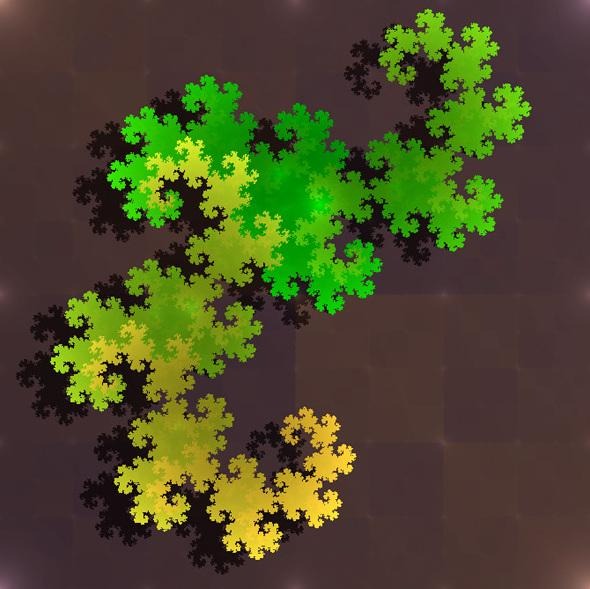 | Koch’s Snowflake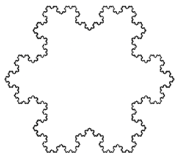 | Mandelbrot Set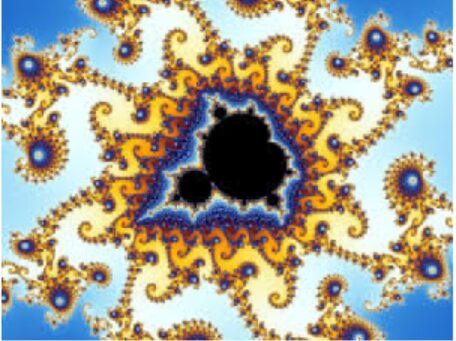 |
I hope that I have convinced you that math isn’t just about “learning the right way to solve a problem”, that there is a depth and beauty to math at its best that can begin to look like art. For every tedious page of long division or brutal Algebra equations that makes you want to run away from math, there is a pattern, sequence of numbers, or new shape that will fascinate and inspire you. So the next time you hear someone say “I hate math”, question them. Ask them what they think math is; they haven’t seen it all yet.